Builder Floor vs Apartment in Gurgaon: Ownership, Rules and Costs in 2026
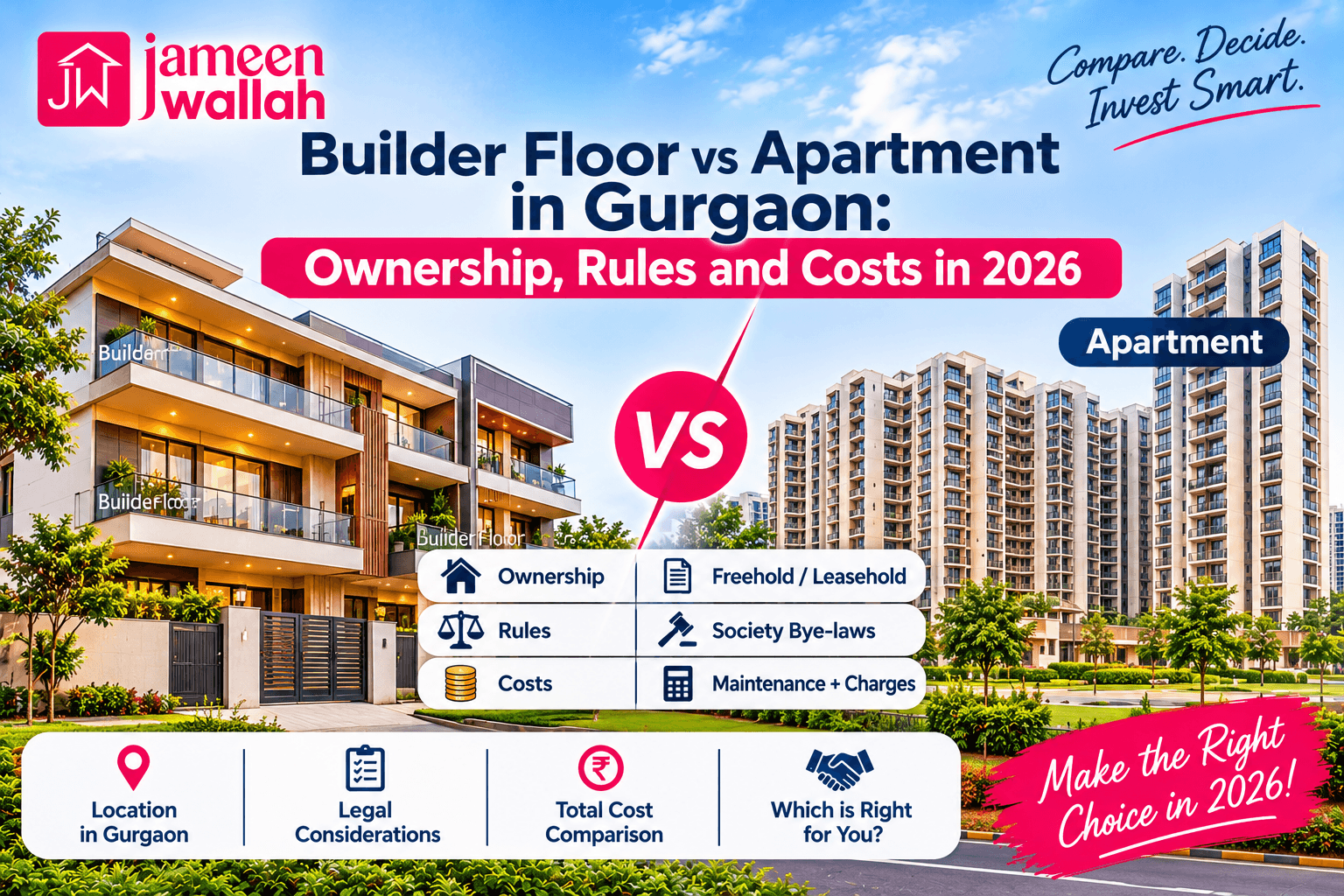
A builder floor is one floor of a low-rise building, usually stilt parking plus up to four floors on an individual residential plot, sold with an undivided share of the land. An apartment is a unit in a multi-storey society with shared amenities and, in registered projects, RERA oversight. Two 2026 facts change how you should compare them. Most single-plot builder floors sit outside RERA, so your protection is the paperwork. And Haryana’s stilt-plus-four policy, notified on 2 July 2024, was stayed by the High Court in April 2026, with fresh approvals frozen by a state memo on 21 July 2026. In the sector price pages we looked at, builder floors listed cheaper per sq ft than flats, but the units, land share and risks differ, so the cheaper number isn’t the whole story.
The two options at a glance
Builder floor | Apartment | |
|---|---|---|
What it is | One floor of a low-rise building on a plot | A unit in a multi-storey society |
Land | A share of the plot, written into the sale deed | A share of common areas and land |
RERA | Usually exempt on small single plots | Registered projects are covered |
Amenities and security | Little or none, no formal agency | Usually club, security, lifts, power backup |
Maintenance | Shared informally with other floor owners | Charged monthly by a society or association |
Space and privacy | Larger units, fewer neighbours | Smaller units, more neighbours |
Main risk | Approvals, plan compliance, civic load | Maintenance cost, density, delivery risk if under construction |
What you actually own
In a standard builder floor purchase, you get a proportionate undivided share in the underlying plot, recorded in the registered sale deed. The same guide gives an example of a stilt-plus-four building on an 1,800 sq ft plot where each of four owners may hold about 25%, or 450 sq ft. That land share is a real part of the appeal, and it’s why the wording of the deed matters.
Practical rights are less tidy. Another guide notes that the roof, the facade, the stilt and future repairs are shared decisions, usually without a formal association to settle arguments. So check who owns the terrace, who gets which parking space and how repairs are split before you buy.
An apartment works differently. The Haryana Apartment Ownership Act, 1983 treats each flat as a distinct, heritable and transferable property while giving the owner an undivided interest in common areas. The association and maintenance structure comes with the building.
RERA: why most builder floors sit outside it
RERA registration is required for projects above a size threshold. Most sources put it at registration being mandatory only above 500 sq m or eight units, and note that a typical builder floor sits on a 250–500 sq yard plot with four units. That puts most single-plot floors outside RERA, so there is no regulator holding the builder to a delivery standard. Is It Safe to Buy a Builder Floor in Gurgaon? +2
A few cautions:
Sources differ on the wording. One page says registration applies from five units, and another from ten. The common version is 500 sq m or more than eight units, so confirm the figures in the Act or with HRERA.
Large plots can cross the line. One guide warns that buyers of a large corner plot in the older DLF phases shouldn’t assume exemption without checking the actual land area against 500 sq m. gurgaonfloors
Some floor projects are registered. Plotted developments and low-rise floor projects above the threshold must register. Search the project on the Haryana RERA site.
Without RERA you don’t get the escrow and delay-interest protections we covered in ready-to-move vs under-construction flats. One guide says your real protection is four documents: the approved building plan, the occupation certificate, a 30-year title search and a sale deed that spells out your undivided land share. Our RERA guide explains the regulator’s role where it does apply.realtyhunting
Stilt+4 in 2026: stay, freeze and what it means
Stilt+4 is the policy that allows four floors above a stilt on eligible plots. The timeline, as reported by several legal and property sources (check it against the official orders):
2 July 2024. Haryana notified the stilt-plus-four rule, allowing four floors above stilt parking. realbetter
17 April 2026. The planning department directed HSVP and the Urban Local Bodies department to act against unauthorised use, occupation or construction on stilt floors and against encroachment of road right-of-way. apexlandbase
April 2026. The Punjab and Haryana High Court stayed the notification, pointing to strained roads, sewage and drainage in Gurgaon.
21 July 2026. A Town and Country Planning memorandum suspended all further stilt-plus-four approvals on residential plots until further orders. The online submission portals were disabled.
This isn’t a permanent ban. Summaries note that the freeze hits new approvals, while buildings already sanctioned, completed and holding an occupation certificate are treated differently. The memo is also worded around further approvals and doesn’t cancel past ones, but enforcement against encroachment and unauthorised stilt occupation can still proceed after due process. The case is still being heard, so the position can change.
What it means for you:
New floors under construction. Ask whether the building has a sanctioned plan that covers every floor being sold. A builder promising approval “in a few weeks” is making a claim the freeze makes hard to rely on.
Ready floors. Check that the sanction, the occupation certificate and the built floors all match. Banks read the sanctioned plan and the certificate when they lend.
Neighbourhood load. Residents’ groups have long objected to plots meant for four apartments being turned into mini-societies of up to 16. A Tribune report cited a 2022 municipal survey naming Sectors 17, 15, 14, 31, 30 and 40 as the worst-affected, where every fifth house had been converted to a four-storey apartment building. That load shows up in water, sewage and drainage, which we cover in waterlogging in Gurgaon.
Price and running costs
On the price pages we used for our property rates in Gurgaon guide, builder floors listed below flats. In Sector 67, 99acres showed flats at about ₹15,150–18,500 per sq ft and builder floors at about ₹10,300–12,400. In Sector 65, flats were about ₹18,500–26,000 and floors about ₹14,400–20,100. The government’s circle rates follow the same pattern: independent floors in HUDA and licensed colonies carry a lower notified value than group-housing flats in Sectors 1–43 (see our circle rates guide).
A lower number per sq ft isn’t the whole comparison. Floors are often larger. One guide says units in luxury builder floors run from about 2,200 to 5,500 sq ft of built-up area. Area bases also differ between floors and apartments, so ask what each price covers, and compare the total cost for the space you’d actually use. Add stamp duty and registration, which follow the same rules for both.
Running costs differ in structure. Apartments charge monthly maintenance for security, lifts, power backup and amenities. Builder floors usually cost less to run, but you or your neighbours arrange repairs, security and sometimes lifts or backup power yourselves.
Loans, resale and daily living
Loans and resale. Banks read the sanctioned plan and the occupation certificate. A floor that doesn’t match its approved plan can be refused a loan, and one guide warns that the municipal corporation can issue notices to seal or demolish unapproved construction. One legal summary says that after the stay buyers are asking sharper questions at resale, so owners should keep sanction, OC and registry copies together.Stilt Plus 4 Floors in Gurgaon: Rules After the Stay +2
Daily living. A floor typically offers more space, fewer neighbours and more privacy, in an established sector with existing schools and markets. An apartment offers security, lifts, power backup and amenities, and often sits in a newer corridor. One guide sums up the trade-off as floors giving space and privacy while societies give services and security. Which matters more depends on your household.
Checks for a builder floor
Title. Ask for the full title chain, going back 30 years where possible, and the plot ownership record.
Sanctioned plan against what is built. Count the floors, check the road width (guides say a plot needs a road at least 10 metres wide for stilt-plus-four, and narrower roads are capped at stilt-plus-three) and match the plan to the building.
Occupation or completion certificate for the building, not just the plot’s licence.
The sale deed. It should identify your floor and state your undivided share, and spell out terrace, stilt and parking rights.
Structural condition. Ask for a structural audit, and check how the neighbouring buildings and plots have been built.
RERA status. Check the actual land area, and search HRERA if the project could cross the threshold.
Notices. Ask whether any sealing, demolition or encroachment notice has been issued for the plot.
Shared repairs. Agree in writing how roof, lift, water tank and facade costs are split.
Utilities. Check the water and sewer connections and electricity metering.
Lawyer. Have a lawyer review the deed and the chain of title.
Checks for an apartment
Search the project on HRERA, check the occupation or completion certificate for a ready flat, read the maintenance terms and association rules, and check the developer’s record. For an under-construction flat, read ready-to-move vs under-construction flats in Gurgaon. For premium units, use the luxury apartment checklist.
Which suits whom
A family that wants space, privacy and a land share and will manage its own building: a builder floor with clean documents.
A buyer who wants security, amenities and a regulator behind the project: an apartment in a registered society.
An investor: the quality of paperwork and the rent a specific unit can fetch matter more than the format. A floor with an OC and a clear deed beats a cheaper one without.
A buyer who needs a home loan: whichever option has a sanctioned plan and an occupation certificate that match what’s built.
Anyone considering a floor with a fourth storey under stilt+4: hold off until the sanction is clear, and have a lawyer read it.
Browse builder floors for sale and residential properties, or see the wider real estate in Gurgaon overview.
Conclusion
A builder floor trades RERA cover and amenities for space, privacy and a share of land, and in 2026 its approvals sit under a court stay. An apartment trades some space and privacy for security, services and a registered project. Whichever you choose, the sanctioned plan, the certificate and the deed decide whether the purchase holds up. When you’re ready, browse residential properties or talk to an advisor.
Frequently Asked Questions
Usually not. Registration is generally needed only above 500 sq m or more than eight units, and a typical floor plot has four units. Large plots and floor projects above the threshold must register, so check.
Haryana’s stilt-plus-four policy (notified 2 July 2024) was stayed by the High Court in April 2026, and a state memo on 21 July 2026 suspended fresh approvals until further orders. Existing sanctioned buildings are treated differently.
In the sector price pages we cited, floors listed lower per sq ft, but floors are often larger and sold on different area bases. Compare total cost for usable space.
Your floor and an undivided share of the plot, as written in the sale deed. Roof, stilt and parking rights depend on the deed, so read it carefully.
Banks look at the sanctioned plan and occupation certificate. A floor that matches its approved plan is financed as before, and one that doesn’t can be refused.
Neither format is better in itself. Clean paperwork, a certificate and realistic rent matter more than the label.
About the Author