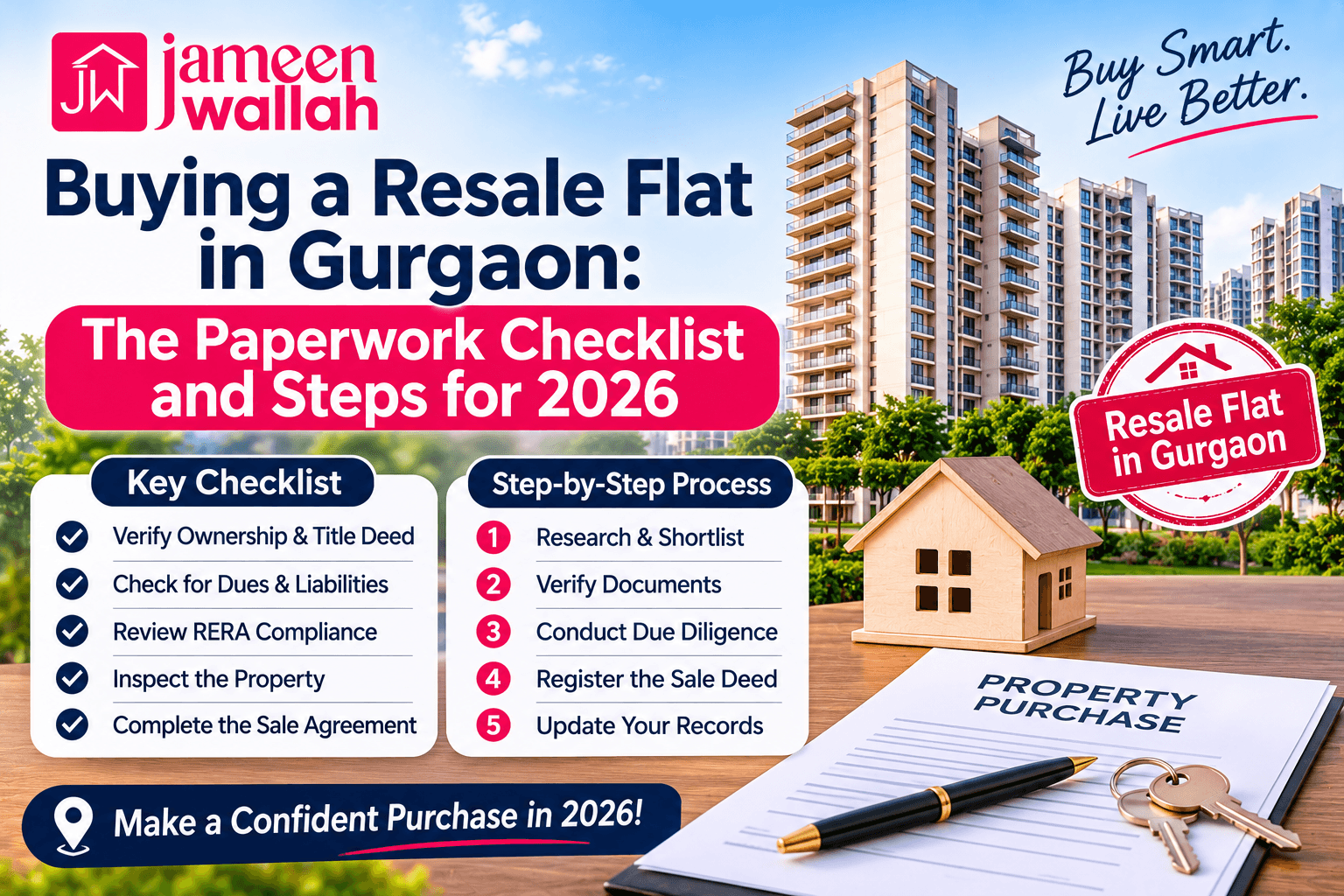
Buying a Resale Flat in Gurgaon: The Paperwork Checklist and Steps for 2026
A resale flat purchase comes down to five things: the seller’s title chain, whether the original registry (the conveyance deed) was done, dues and no-objection certificates, a registered sale deed at the right value, and TDS. Stamp duty is charged on the higher of your agreement value and the circle-rate value. From 1 April 2026, a buyer paying a resident seller ₹50 lakh or more must deduct 1% TDS under section 393 of the Income-tax Act 2025, and an NRI seller changes the rules entirely. The documents you need depend on the kind of resale: a flat that is already registered, or one still under construction and being resold before registry.
Two kinds of resale
A Gurgaon broker guide describes the split. Resale happens either when a property is under construction and being sold before registry, or when it is ready to move and already registered, and the two differ mainly in the transfer process, which shows up as a sale deed versus a conveyance deed.
Ready and registered. The first buyer already took the registry from the builder. You buy under a sale deed from the current owner. The papers to read are the conveyance deed, the sale deed and the chain behind them.
Under construction, resale before registry. There is no registered deed in the seller’s name yet. You take over the builder’s records instead. A broker confirms with the builder’s office in whose name the unit is allotted, whose name is on the builder buyer agreement and whether the payment records match the seller’s documents. For the risks of waiting on a builder, see ready-to-move vs under-construction flats in Gurgaon.
Documents to check before you pay
Document | What it shows | What to watch for |
|---|---|---|
Sale deed and title chain | The seller owns the flat, with an unbroken history | Gaps, missing earlier deeds, a seller who can’t produce originals |
Conveyance deed | The builder transferred the flat to the first buyer | None executed, or a deed that doesn’t match the flat |
Builder buyer agreement, allotment letter, payment receipts, possession letter | The builder’s side of the story | Names, amounts or unit numbers that don’t match |
Occupancy or completion certificate and approved plan | The building was legally completed | No certificate, or a plan that differs from what is built |
Encumbrance certificate | No mortgage, lien or legal dues for the period covered | Entries you can’t explain |
No-dues certificate and maintenance receipts | Society or builder dues are cleared | Unpaid maintenance, club or parking charges |
Property tax receipts and utility bills | No tax or utility arrears | Outstanding dues that pass to you |
Bank NOC or loan closure letter | Any loan on the flat is closed or will be | A past loan with no written closure |
Society share certificate or membership record | The seller is a member who can transfer | A transfer the society hasn’t approved |
Guides agree on the core list. The title deed should establish the complete chain of title, ideally going back 30 years, and the encumbrance certificate is typically sought for a period of about 13 to 30 years. For a resale home, verify the title chain, the sale deed and a no-dues certificate, and for a resale flat confirm the society dues and the occupancy certificate. One checklist adds mutation status and the previous owner’s occupancy and completion certificates for resale flats. Cross-check the chain at the sub-registrar’s records, and check the project on the Haryana RERA site if it was a registered project. Our RERA guide explains what to read. Gurgaon Real Estate Guide 2026: Fees, Documentation & Best Practices +2
Mortgaged flats and unpaid dues
A flat with a loan can still be bought, but only with a clear paper trail. One guide says you need the loan account statement, the bank’s written NOC confirming the loan will be or has been closed, and the original title documents released by the lender before registration. The usual route is the buyer paying part of the price directly to the bank to close the loan, the bank issuing its NOC and releasing the original documents, and the rest of the price going to the seller. Don’t pay the seller in full and hope the loan closes later.
Dues travel with the flat. Ask for a no-dues certificate covering property tax and maintenance, and the society share certificate for transfer. Get receipts for the last several months of maintenance, electricity and water, and agree in writing who pays anything outstanding. In a society, check the transfer fee and who must sign off.
The money: stamp duty and TDS
Stamp duty and registration. Duty is charged on the higher of the agreement value and the circle-rate value, at 7% for men, 5% for women and 6% for joint male–female buyers in urban Gurugram. On a ₹1.5 crore agreement at 7%, that’s ₹10.5 lakh, or ₹7.5 lakh at 5% (arithmetic only). Our guide to Gurgaon circle rates 2026-27 covers the rates, the sums and the registration-fee uncertainty. There is no GST on a resale flat.
TDS from a resident seller. This is the step many buyers miss. If you buy a property for ₹50 lakh or more from a resident seller, you must deduct 1% TDS from the price, deposit it with the Income Tax Department and file the prescribed form, and from 1 April 2026 the rule sits in section 393 of the Income-tax Act, 2025 (earlier section 194-IA). The test looks at the larger of the two values: if the stamp duty value exceeds the sale price and is above ₹50 lakh, TDS is calculated on the higher value. On a ₹1.5 crore deal that’s ₹1.5 lakh withheld from the seller’s payment (arithmetic only). If you don’t deduct, you become an assessee in default, and the seller agreeing to compensate you doesn’t remove your liability to the Income Tax Department. Sources disagree on the form name: reports say Form 141 replaces 26QB for new transactions, so check which one the e-filing portal shows. TDS on Property Purchase 2026: 1% Rule, Form 141/26QB +3
TDS from an NRI seller. It’s very different. There is no ₹50 lakh threshold, and the TDS is 12.5% plus surcharge and cess on the full price for a long-term asset, not 1%. On ₹1.5 crore, 12.5% alone is ₹18.75 lakh before surcharge and cess (arithmetic only). A summary warns that deducting only 1% from an NRI seller leaves the buyer liable for the shortfall. The usual route to a lower deduction is a certificate from the seller’s tax officer, so talk to a chartered accountant before agreeing a price.
Also budget for the maintenance deposit, society transfer fee and any brokerage. See our guide to property taxes in Haryana.
Step by step
Shortlist and inspect. Visit the flat, the building and the surroundings at different times of day. For rain-related checks, see waterlogging in Gurgaon.
Check the price. Compare with recent sales and asking prices. Our property rates in Gurgaon guide explains why portals disagree.
Collect and verify the documents in the table above. Have a lawyer review them.
Sign the agreement to sell with the price, payment schedule, possession date, who clears dues and the TDS arrangement written in.
Arrange your loan. The bank will run its own legal and technical checks. A home loan advisor can help you prepare.
Pay duty, deduct TDS and deposit it. Pay through banking channels, and keep the challans.
Register the sale deed. Buyer and seller must both be present with two witnesses, with photographs and biometrics taken, and you should carry all originals even if copies were uploaded online. The same guide says the process normally takes at least three weeks, and documents must be registered within four months of execution under Section 23 of the Registration Act 1908. eliteedgelegacyeliteedgelegacy
Take possession and transfer. Apply to the society for membership transfer with the registered deed, the seller’s no-dues and the transfer fee, and get the share certificate or allotment updated. Then transfer electricity, water and property tax records, and collect the original papers. After registration the supporting originals such as the builder buyer agreement, allotment letter, payment receipts and possession letter are handed over.
Red flags
The seller can’t or won’t show original documents.
There are gaps in the chain, or names that don’t match across deeds.
No conveyance deed was ever executed for a flat sold as “ready”.
A loan on the flat with no written closure plan.
A request to register at a value below the real price, or to pay a large part in cash. Declare the actual price and pay through banking channels.
A sale through a power of attorney in place of a registered sale deed. Get a lawyer’s opinion before going further.
Dues or notices the seller hasn’t mentioned.
A flat with extra floors or changes that don’t match the sanctioned plan. See builder floor vs apartment in Gurgaon for more on approval problems.
Pressure to pay a large token before you’ve seen the documents.
Who to involve
A lawyer for title and the deed, a home loan advisor if you’re borrowing, and a chartered accountant for TDS, especially for an NRI seller. For premium homes, our luxury apartment checklist adds quality checks.
Conclusion
A resale flat is only as good as its paperwork. Establish the chain, confirm the conveyance, clear the dues and the loan, deduct TDS properly and register the deed at the true value. When you’re ready, browse residential properties or talk to an advisor.
Frequently Asked Questions
The sale deed and title chain, conveyance deed, occupancy certificate, encumbrance certificate, no-dues certificate, tax receipts and a bank NOC if the flat was mortgaged.
A conveyance deed is the builder’s transfer of the flat to the first buyer. A sale deed transfers ownership from one owner to the next, such as from the first buyer to you.
If the seller is a resident and the price or stamp duty value is ₹50 lakh or more, you deduct 1% under section 393 of the Income-tax Act 2025. NRI sellers attract much higher TDS from the first rupee.
One guide says at least three weeks from start to finish, and documents must be registered within four months of execution. Confirm with the sub-registrar.
Yes, with the lender’s consent, a written NOC and the original documents released before registration. The usual route is to pay the bank directly.
No. GST applies to under-construction flats bought from a developer.
About the Author