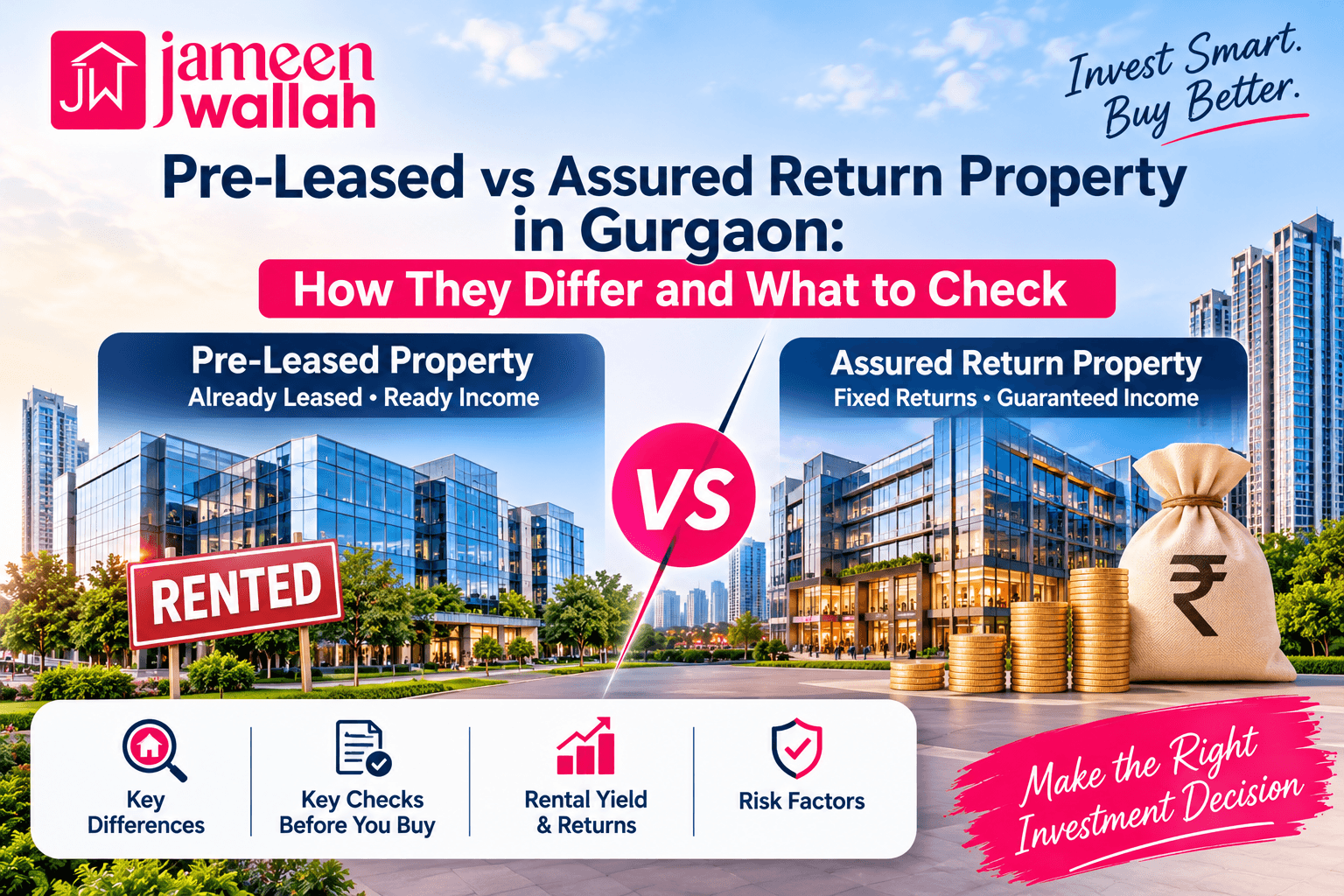
Pre-Leased vs Assured Return Property in Gurgaon: How They Differ and What to Check
In a pre-leased property, a tenant pays rent under a lease. In an assured-return deal, the developer pays you a fixed return from its own funds, usually on an under-construction or unleased commercial unit. That is the core difference, and it determines the risk. In the real pre-leased listings we reviewed, stated yields ran at about 4–6%, with nine-year leases and three- or four-year lock-ins. Assured-return launches on broker pages promise 10–12% and in some cases 18–24%. A higher promised return means more depends on the developer. HRERA Gurugram has enforced assured-return agreements in several orders, but a complaint to a regulator is a dispute route, not protection, and outcomes depend on the contract. This guide compares both structures and lists what to ask before you sign.
The core difference: who pays
Pre-leased | Assured return | |
|---|---|---|
Who pays the income | A tenant, under a lease | The developer, under an agreement |
Source of the payment | Tenant’s business | Developer’s own funds |
Typical return quoted | About 4–6% in real listings; higher on generic pages | 10–12%, sometimes 18–24% on broker pages |
Main risk | Tenant leaves after lock-in; rent may be subsidised | Developer stops or delays paying |
Usual duration | Lease of about nine years, lock-in of three to four | Often until possession or a fixed period |
When it suits | You want a verifiable tenant | You’ve vetted the developer and accept the downside |
For the commercial types where these structures appear, see buying office space in Gurgaon and buying a shop in Gurgaon.
How pre-leased property works
A pre-leased unit is sold with a tenant already in place. The tenant pays rent under a lease, and the buyer steps into the landlord’s position. The listings show a fairly consistent pattern:
Leases of nine years with a four-year lock-in on some office listings. qwikkreturns
On one Golf Course Extension Road listing, rent of ₹90 per sq ft per month, a five-month deposit, 15% escalation after three years, a four-year lock-in and a nine-year lease, giving a stated 6% return. prithviestates
Broker pages commonly describe a strict three-year lock-in during which the tenant cannot break the lease. propzilla
The lock-in is the period your rent is contractually secure. After that, the tenant can usually leave, and you carry the vacancy.
Watch for these risks:
Subsidised rent. One broker guide warns that a developer may be subsidising the rent on a “pre-leased” unit, so the tenant isn’t really the one paying. assuredgains
Tenant strength. One broker’s view is that bank tenants are safer but pay yields about two to three percentage points lower than IT or MNC leases. That is a broker’s opinion and not a rule, but it shows the trade-off between safety and yield.
Rent-free periods. Some leases give the tenant months without rent for fit-out, which reduces first-year income.
Operator risk. If the tenant is a flex or co-working operator, you depend on that operator’s business.
How assured return works
In an assured-return deal there may be no tenant at all. The developer pays a return from its own funds, and such schemes typically promise higher yields of 10–24% while carrying the developer’s solvency risk. Broker pages list 12% assured pre-possession returns on some launches and 10–12% on some and 18–24% on others. Pre-Leased Property for Sale in Gurgaon 2026 +2
The return usually runs for a fixed period or until possession. After that, you need a real tenant, and the real rent may be much lower. An illustration (arithmetic only, not a market claim). On a ₹1 crore unit, a 12% assured return pays ₹12 lakh a year, or ₹36 lakh over three years. If the unit then leases at a 6% yield, income drops to ₹6 lakh a year. Judge the deal by the yield you can expect after the assured period, not before it.
It’s also worth asking whether the price is higher to fund the return. A Noida broker page notes a large price difference between neighbouring projects with and without assured returns. That is a Noida observation and an inference for Gurgaon, so test it by comparing comparable units. commercialnoida
When assured returns stop: what HRERA has said
Buyers who haven’t been paid have taken cases to HRERA. A few examples show both the remedy and its limits:
In an order reported in late 2025, HRERA Gurugram directed a developer to pay agreed assured monthly returns, hand over a delayed commercial unit and execute the conveyance deed, noting that the obligation to pay continued until possession was offered after an occupation certificate. Arrears carried interest of 8.85% a year if not settled within 90 days. 24law
In another case, the Haryana bench held that the Banning of Unregulated Deposit Schemes Act did not bar payment of assured returns by a builder to a buyer.legaleraonline
The authority has not always taken the same view. A buyer-side legal summary notes that HRERA has taken different views over time, including that an assured return clause isn’t about possession and so may fall outside RERA. tripakshalitigation
The takeaway is practical. A regulator can enforce a written agreement, but the process takes time, the outcome depends on the contract and the facts, and the law has not been consistent. That is why the agreement matters more than the pitch. This article is not legal advice, so have a lawyer read any assured-return document.
Questions to ask before you sign
For a pre-leased unit
Is the lease deed registered, and can I read all of it?
Who is the tenant, what do they do and for how long have they operated?
What are the rent, escalation, lock-in, deposit and exit clauses?
Is there a rent-free or fit-out period?
Can I see rent receipts or bank statements showing the tenant, not the developer, pays?
How does the rent compare with other leases in the same building?
Can the tenant sub-let, and who holds the deposit?
For an assured-return unit
Who pays, from what, and for how long?
What ends the payments: possession, a date or a tenant?
Is the commitment in the registered agreement, or only in a brochure or email?
Is there any security, such as an escrow or guarantee? Ask what happens if the developer stops paying.
What is the developer’s delivery record? Check our builders directory and search HRERA for complaints.
Is the project registered? Search the Haryana RERA site, and read our RERA guide.
Is the price higher than comparable units without the assured return?
How will the income be taxed? Ask a CA, and see our guide to property taxes in Haryana.
Red flags
A headline return above about 10% with no named tenant or written terms.
“Guaranteed” language that isn’t in the agreement.
Pressure to pay quickly, or a promise that only holds if you book this week.
An unregistered or missing lease or agreement.
A developer with delayed projects or open HRERA complaints.
A price well above comparable units.
Rent that comes from “a company arranged by the developer”.
Which suits whom
A buyer who wants a verifiable tenant and a clear exit: pre-leased, after reading the lease and testing the tenant.
A buyer who is comfortable with developer risk: assured return, only after vetting the developer and pricing in the period after payments end.
A buyer who wants the higher headline number without the risk: this doesn’t exist. Higher promised returns come with more dependence on someone’s ability to pay.
If you’re unsure, a financing advisor can help stress-test the numbers, and our overview of commercial property in Gurgaon shows how these units fit into the wider market.
Conclusion
Pre-leased and assured return both promise income, but they put the risk in different places. In one a tenant pays, and in the other a developer does. Read the lease or the agreement, check who is paying and for how long, and judge the deal by what you’d earn after any assured period ends. When you’re ready, browse office spaces, retail spaces or commercial properties, or talk to an advisor.
Frequently Asked Questions
A fixed return the developer promises to pay on a unit, often during construction or until possession, from its own funds and not from a tenant.
It depends on the developer and the written agreement. The return is only as strong as the party paying it, so check the developer’s record and the contract.
Assured-return offers promise more, at 10–12% and in some cases higher, but carry more risk. Real pre-leased listings we reviewed stated about 4–6%.
The period during which a tenant cannot end the lease early. Listings often show three or four years within a nine-year lease.
Buyers have filed complaints with HRERA, and the Gurugram bench has ordered payment with interest in some cases. Outcomes depend on the agreement, so get legal advice.
Yes. Broker guides warn that a developer may subsidise the rent. Ask for rent receipts or bank statements showing the tenant pays.
About the Author